


Page 129 - Proceedings Collega2023
P. 129
countries and learning how to work remotely and online. However, the disadvantage of remote learning
               for heritage studies is the need for on-site experience that could only be gained by visiting the heritage
               sites physically.


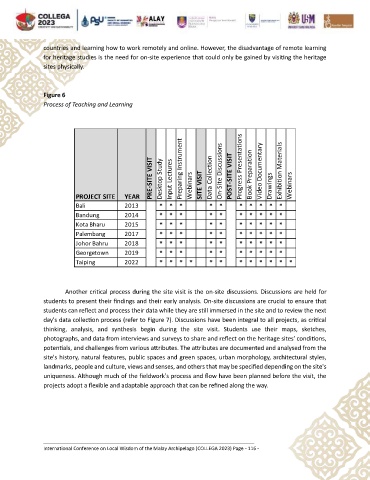
               Figure 6
               Process of Teaching and Learning


                                                   PRE-SITE VISIT  Desktop Study  Input Lectures  Preparing Instrument  Webinars  SITE VISIT  Data Collection  On-Site Discussions  POST-SITE VISIT  Progress Presentations  Book Preparation  Video Documentary  Drawings  Exhibition Materials  Webinars


                          PROJECT SITE    YEAR
                          Bali            2013        * * *           * *       * * * * *
                          Bandung         2014        * * *           * *       * * * * *
                          Kota Bharu      2015        * * *           * *       * * * * *
                          Palembang       2017        * * *           * *       * * * * *
                          Johor Bahru     2018        * * *           * *       * * * * *
                          Georgetown      2019        * * *           * *       * * * * *
                          Taiping         2022        * * * *         * *       * * * * * *


                       Another critical process during the site visit is the on-site discussions. Discussions are held for
               students to present their findings and their early analysis. On-site discussions are crucial to ensure that
               students can reflect and process their data while they are still immersed in the site and to review the next
               day's data collection process (refer to Figure 7). Discussions have been integral to all projects, as critical
               thinking,  analysis,  and  synthesis  begin  during  the  site  visit.  Students  use  their  maps,  sketches,
               photographs, and data from interviews and surveys to share and reflect on the heritage sites' conditions,
               potentials, and challenges from various attributes. The attributes are documented and analysed from the
               site's history, natural features, public spaces and green spaces, urban morphology, architectural styles,
               landmarks, people and culture, views and senses, and others that may be specified depending on the site's
               uniqueness. Although much of the fieldwork's process and flow have been planned before the visit, the
               projects adopt a flexible and adaptable approach that can be refined along the way.


               International Conference on Local Wisdom of the Malay Archipelago (COLLEGA 2023) Page - 116 -

