


Page 128 - Proceedings Collega2023
P. 128
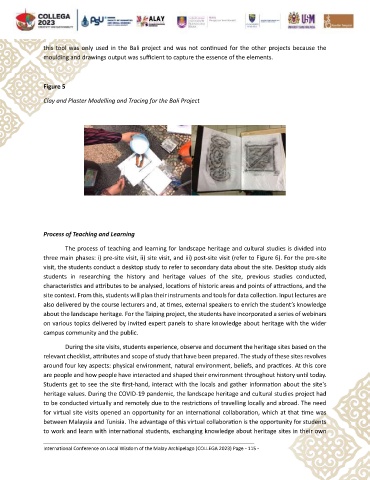
this tool was only used in the Bali project and was not continued for the other projects because the
               moulding and drawings output was sufficient to capture the essence of the elements.


               Figure 5

               Clay and Plaster Modelling and Tracing for the Bali Project


               Process of Teaching and Learning

                       The process of teaching and learning for landscape heritage and cultural studies is divided into
               three main phases: i) pre-site visit, ii) site visit, and iii) post-site visit (refer to Figure 6). For the pre-site
               visit, the students conduct a desktop study to refer to secondary data about the site. Desktop study aids
               students  in  researching  the  history  and  heritage  values  of  the  site,  previous  studies  conducted,
               characteristics and attributes to be analysed, locations of historic areas and points of attractions, and the
               site context. From this, students will plan their instruments and tools for data collection. Input lectures are
               also delivered by the course lecturers and, at times, external speakers to enrich the student’s knowledge
               about the landscape heritage. For the Taiping project, the students have incorporated a series of webinars
               on various topics delivered by invited expert panels to share knowledge about heritage with the wider
               campus community and the public.

                       During the site visits, students experience, observe and document the heritage sites based on the
               relevant checklist, attributes and scope of study that have been prepared. The study of these sites revolves
               around four key aspects: physical environment, natural environment, beliefs, and practices. At this core
               are people and how people have interacted and shaped their environment throughout history until today.
               Students get to see the site first-hand, interact with the locals and gather information about the site's
               heritage values. During the COVID-19 pandemic, the landscape heritage and cultural studies project had
               to be conducted virtually and remotely due to the restrictions of travelling locally and abroad. The need
               for virtual site visits opened an opportunity for an international collaboration, which at that time was
               between Malaysia and Tunisia. The advantage of this virtual collaboration is the opportunity for students
               to work and learn with international students, exchanging knowledge about heritage sites in their own


               International Conference on Local Wisdom of the Malay Archipelago (COLLEGA 2023) Page - 115 -

