


Page 125 - Proceedings Collega2023
P. 125
Results and Findings

               Instruments and Tools

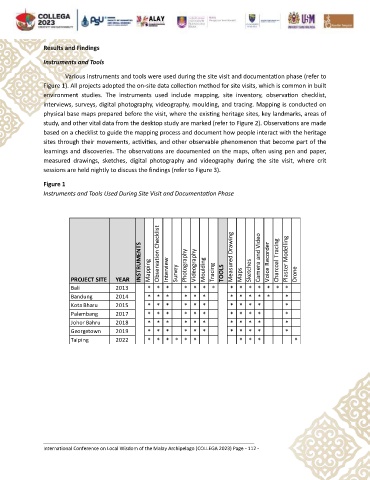
                       Various instruments and tools were used during the site visit and documentation phase (refer to
               Figure 1). All projects adopted the on-site data collection method for site visits, which is common in built
               environment  studies.  The  instruments  used  include  mapping,  site  inventory,  observation  checklist,
               interviews, surveys, digital photography, videography, moulding, and tracing. Mapping is conducted on
               physical base maps prepared before the visit, where the existing heritage sites, key landmarks, areas of
               study, and other vital data from the desktop study are marked (refer to Figure 2). Observations are made
               based on a checklist to guide the mapping process and document how people interact with the heritage
               sites through their movements, activities, and other observable phenomenon that become part of the
               learnings and discoveries. The observations are documented on the maps, often using pen and paper,
               measured  drawings,  sketches,  digital  photography  and  videography  during  the  site  visit,  where  crit
               sessions are held nightly to discuss the findings (refer to Figure 3).

               Figure 1
               Instruments and Tools Used During Site Visit and Documentation Phase


                                                INSTRUMENTS  Observation Checklist  Interview  Photography  Videography  Moulding  Measured Drawing  Camera and Video  Voice Recorder  Charcoal Tracing  Plaster Modelling


                        PROJECT SITE   YEAR        Mapping  Survey      Tracing  TOOLS  Maps  Sketches  Drone
                        Bali           2013       * * *       * * * *        * * * * * * *
                        Bandung        2014       * * *       * * *          * * * * *         *
                        Kota Bharu     2015       * * *       * * *          * * * *           *
                        Palembang      2017       * * *       * * *          * * * *           *
                        Johor Bahru    2018       * * *       * * *          * * * *           *
                        Georgetown     2019       * * *       * * *          * * * *           *
                        Taiping        2022       * * * * * *                   * * *             *


               International Conference on Local Wisdom of the Malay Archipelago (COLLEGA 2023) Page - 112 -

