


Page 131 - Proceedings Collega2023
P. 131
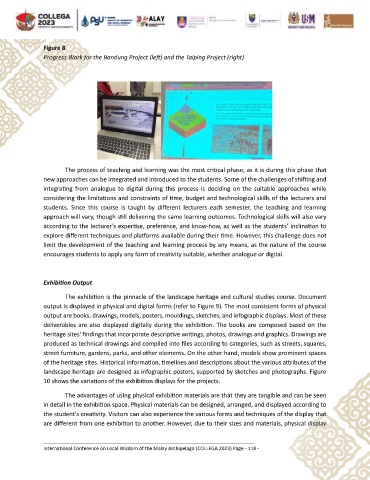
Figure 8
               Progress Work for the Bandung Project (left) and the Taiping Project (right)


                       The process of teaching and learning was the most critical phase, as it is during this phase that
               new approaches can be integrated and introduced to the students. Some of the challenges of shifting and
               integrating  from  analogue  to  digital  during  this  process  is  deciding  on  the  suitable  approaches  while
               considering the limitations and constraints of time, budget and technological skills of the lecturers and
               students.  Since  this  course  is  taught  by  different  lecturers  each  semester,  the  teaching  and  learning
               approach will vary, though still delivering the same learning outcomes. Technological skills will also vary
               according to the lecturer’s expertise, preference, and know-how, as well as the students’ inclination to
               explore different techniques and platforms available during their time. However, this challenge does not
               limit the development of the teaching and learning process by any means, as the nature of the course
               encourages students to apply any form of creativity suitable, whether analogue or digital.


               Exhibition Output

                       The exhibition is the pinnacle of the landscape heritage and cultural studies course. Document
               output is displayed in physical and digital forms (refer to Figure 9). The most consistent forms of physical
               output are books, drawings, models, posters, mouldings, sketches, and infographic displays. Most of these
               deliverables are also displayed digitally during the exhibition. The books are composed based on the
               heritage sites' findings that incorporate descriptive writings, photos, drawings and graphics. Drawings are
               produced as technical drawings and compiled into files according to categories, such as streets, squares,
               street furniture, gardens, parks, and other elements. On the other hand, models show prominent spaces
               of the heritage sites. Historical information, timelines and descriptions about the various attributes of the
               landscape heritage are designed as infographic posters, supported by sketches and photographs. Figure
               10 shows the variations of the exhibition displays for the projects.

                       The advantages of using physical exhibition materials are that they are tangible and can be seen
               in detail in the exhibition space. Physical materials can be designed, arranged, and displayed according to
               the student's creativity. Visitors can also experience the various forms and techniques of the display that
               are different from one exhibition to another. However, due to their sizes and materials, physical display


               International Conference on Local Wisdom of the Malay Archipelago (COLLEGA 2023) Page - 118 -

