


Page 127 - Proceedings Collega2023
P. 127
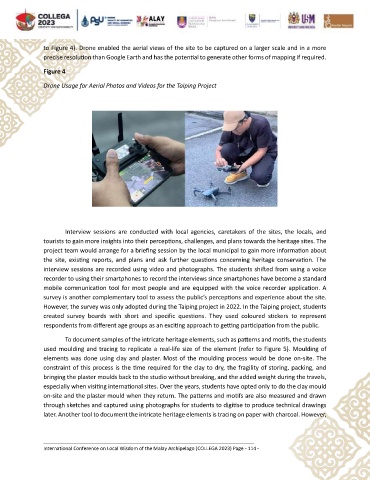
to Figure 4). Drone enabled the aerial views of the site to be captured on a larger scale and in a more
               precise resolution than Google Earth and has the potential to generate other forms of mapping if required.

               Figure 4

               Drone Usage for Aerial Photos and Videos for the Taiping Project


                       Interview  sessions  are  conducted  with  local  agencies,  caretakers  of  the  sites,  the  locals,  and
               tourists to gain more insights into their perceptions, challenges, and plans towards the heritage sites. The
               project team would arrange for a briefing session by the local municipal to gain more information about
               the  site,  existing  reports,  and  plans  and  ask  further  questions  concerning  heritage  conservation.  The
               interview sessions are recorded using video and photographs. The students shifted from using a voice
               recorder to using their smartphones to record the interviews since smartphones have become a standard
               mobile communication tool for most people and are equipped with the voice recorder application. A
               survey is another complementary tool to assess the public’s perceptions and experience about the site.
               However, the survey was only adopted during the Taiping project in 2022. In the Taiping project, students
               created  survey  boards  with  short  and  specific  questions.  They  used  coloured  stickers  to  represent
               respondents from different age groups as an exciting approach to getting participation from the public.

                       To document samples of the intricate heritage elements, such as patterns and motifs, the students
               used moulding and tracing to replicate a real-life size of the element (refer to Figure 5). Moulding of
               elements was done using clay and plaster. Most of the moulding process would be done on-site. The
               constraint of this process is the time required for the clay to dry, the fragility of storing, packing, and
               bringing the plaster moulds back to the studio without breaking, and the added weight during the travels,
               especially when visiting international sites. Over the years, students have opted only to do the clay mould
               on-site and the plaster mould when they return. The patterns and motifs are also measured and drawn
               through sketches and captured using photographs for students to digitise to produce technical drawings
               later. Another tool to document the intricate heritage elements is tracing on paper with charcoal. However,


               International Conference on Local Wisdom of the Malay Archipelago (COLLEGA 2023) Page - 114 -

