


Page 777 - Proceedings Collega2023
P. 777
2) The confusion between Patani Malay identity and Thai-Buddhist identity: From 1977 - 1987,
               Patani Malay people mostly used the Patani Malay language. After 2004, it was found that many people
               used Thai. That is the effect of confusion about their identity. The people who used only the Patani Malay
               language were less confused about their identity than those who used the Patani Malay language and Thai
               language because Thai is representative of Thai people who are mostly Buddhists. (Prachuabmoh, 2007)

                       Furthermore,  Patani  Malay  people  refer  to  themselves  as  "Patani  Malay"-  a  term  that
               encompasses Islamic faith and Patani Malay ethnicity. This is a clear manifestation of a distinct identity
               that  is  different  from  Thai-Buddhist.  Patani  Malay  people  desire  to  preserve  their  identity  by
               communicating in the Patani Malay language. (Saleh, 2016)

                       3) The area of the Patani Malay identity: Teaching and studying in tadika offer on opportunity to
               share, present, and promote the identity of the Patani Malay people. Accordingly, tadika are the primary
               schools for teaching the Jawi language and Patani Malay identity. (Pienkhuntod, 2019)

                       In conclusion, the identity of Patani Malay people is linked to the education policies that prioritize
               the teaching of the central Thai language and Thai culture. That effectively dilutes Patani Malay identity.
               However, teaching in Tadika is part of preserving Patani Malay identity because the teachers can use Patani
               Malay language to teach Jawi, and Rumi scripts. Thus, this article uses the identity of Patani Malay people
               to analyze how tadika are an important part of revitalizing and preserving Patani Malay identity.

               MTB-BE concept

                       Premsirat  (2015)  introduced  The  Patani  -  Malay  Thai  Bilingual  Education  research  project  in
               schools near the southern border of Thailand. The objective is to provide an effective and suitable teaching
               and learning approach for Malay-speaking children by developing their cognitive skills as well as their
               ability to use Thai as a language of learning by initially using local language and cultural knowledge and
               then transferring their ability to studying Thai. Community academics and other stakeholders are actively
               involved in every stage of the working process, especially in the development of orthography, curriculum,
               lesson planning, instruction material production, and teaching within the framework of bilingual education
               using the child-centered principle. The project shows very positive results. (Premsrirat. S, 2015)
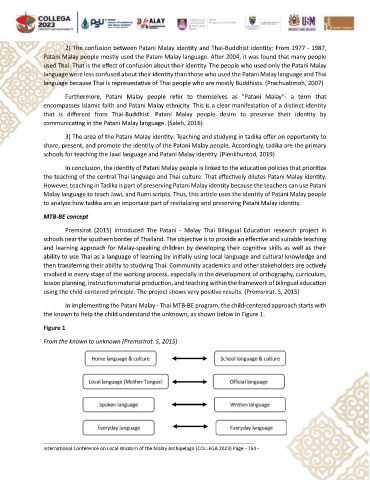
                       In implementing the Patani Malay - Thai MTB-BE program, the child-centered approach starts with
               the known to help the child understand the unknown, as shown below in Figure 1.

               Figure 1

               From the known to unknown (Premsrirat. S, 2015)


               International Conference on Local Wisdom of the Malay Archipelago (COLLEGA 2023) Page - 764 -

