


Page 966 - Proceedings Collega2023
P. 966
surrounding area necessary for formulating richer attachment attributes due to the changing function of
               the palace. The existence of this architecture is because of the public, and hence they stand by the past
               for the present and for the coming future.

               Methodology

                       The research is qualitative in nature and relies heavily on experience, visual documentation, and
               observation. Thus, the phenomenology of architecture to experience a space through place attachment
               is observed while employing the Istana Jahar as a case study.

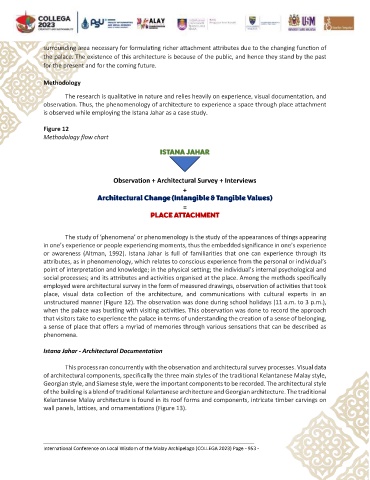
               Figure 12
               Methodology flow chart

                                                      ISTANA JAHAR


                                       Observation + Architectural Survey + Interviews
                                                              +
                                 Architectural Change (Intangible & Tangible Values)
                                                              =
                                                   PLACE ATTACHMENT


                       The study of ‘phenomena’ or phenomenology is the study of the appearances of things appearing
               in one’s experience or people experiencing moments, thus the embedded significance in one’s experience
               or  awareness  (Altman,  1992).  Istana  Jahar  is  full  of  familiarities  that  one  can  experience  through  its
               attributes, as in phenomenology, which relates to conscious experience from the personal or individual’s
               point of interpretation and knowledge; in the physical setting; the individual’s internal psychological and
               social processes; and its attributes and activities organised at the place. Among the methods specifically
               employed were architectural survey in the form of measured drawings, observation of activities that took
               place,  visual  data  collection  of  the  architecture,  and  communications  with  cultural  experts  in  an
               unstructured manner (Figure 12). The observation was done during school holidays (11 a.m. to 3 p.m.),
               when the palace was bustling with visiting activities. This observation was done to record the approach
               that visitors take to experience the palace in terms of understanding the creation of a sense of belonging,
               a sense of place that offers a myriad of memories through various sensations that can be described as
               phenomena.

               Istana Jahar - Architectural Documentation

                       This process ran concurrently with the observation and architectural survey processes. Visual data
               of architectural components, specifically the three main styles of the traditional Kelantanese Malay style,
               Georgian style, and Siamese style, were the important components to be recorded. The architectural style
               of the building is a blend of traditional Kelantanese architecture and Georgian architecture. The traditional
               Kelantanese Malay architecture is found in its roof forms and components, intricate timber carvings on
               wall panels, lattices, and ornamentations (Figure 13).


               International Conference on Local Wisdom of the Malay Archipelago (COLLEGA 2023) Page - 953 -

