


Page 964 - Proceedings Collega2023
P. 964
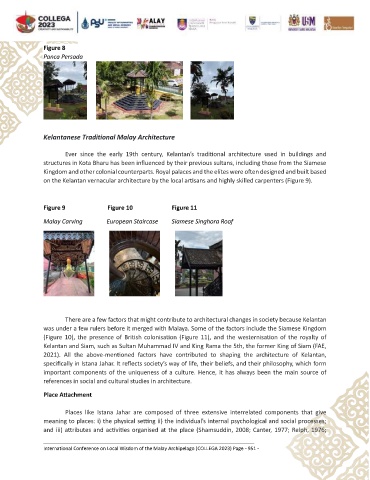
Figure 8
               Panca Persada


               Kelantanese Traditional Malay Architecture

                        Ever  since  the  early  19th  century,  Kelantan’s  traditional  architecture  used  in  buildings  and
               structures in Kota Bharu has been influenced by their previous sultans, including those from the Siamese
               Kingdom and other colonial counterparts. Royal palaces and the elites were often designed and built based
               on the Kelantan vernacular architecture by the local artisans and highly skilled carpenters (Figure 9).


               Figure 9                            Figure 10                          Figure 11

               Malay Carving                European Staircase         Siamese Singhora Roof


                       There are a few factors that might contribute to architectural changes in society because Kelantan
               was under a few rulers before it merged with Malaya. Some of the factors include the Siamese Kingdom
               (Figure  10), the  presence of  British  colonisation  (Figure  11),  and the  westernisation  of  the royalty of
               Kelantan and Siam, such as Sultan Muhammad IV and King Rama the 5th, the former King of Siam (FAE,
               2021).  All  the  above-mentioned  factors  have  contributed  to  shaping  the  architecture  of  Kelantan,
               specifically in Istana Jahar. It reflects society’s way of life, their beliefs, and their philosophy, which form
               important components of the uniqueness of a culture. Hence, it has always been the main source of
               references in social and cultural studies in architecture.

               Place Attachment

                       Places  like  Istana  Jahar  are  composed  of  three  extensive  interrelated  components  that  give
               meaning to places: i) the physical setting ii) the individual’s internal psychological and social processes;
               and iii) attributes and activities organised at the place (Shamsuddin, 2008; Canter, 1977; Relph, 1976;


               International Conference on Local Wisdom of the Malay Archipelago (COLLEGA 2023) Page - 951 -

