


Page 963 - Proceedings Collega2023
P. 963
achieved and can indirectly symbolise the identity of a race or nation. Istana Jahar design is a combination
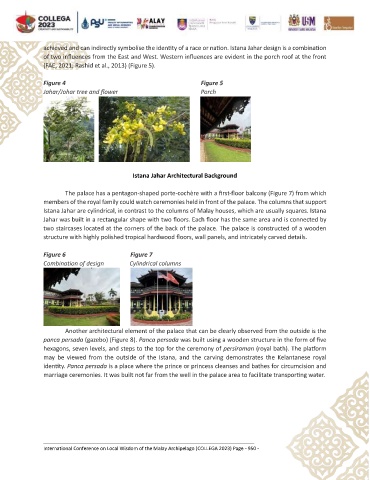
               of two influences from the East and West. Western influences are evident in the porch roof at the front
               (FAE, 2021; Rashid et al., 2013) (Figure 5).

               Figure 4                                                                                          Figure 5
               Jahar/Johar tree and flower                                                       Porch


                                             Istana Jahar Architectural Background

                       The palace has a pentagon-shaped porte-cochère with a first-floor balcony (Figure 7) from which
               members of the royal family could watch ceremonies held in front of the palace. The columns that support
               Istana Jahar are cylindrical, in contrast to the columns of Malay houses, which are usually squares. Istana
               Jahar was built in a rectangular shape with two floors. Each floor has the same area and is connected by
               two staircases located at the corners of the back of the palace. The palace is constructed of a wooden
               structure with highly polished tropical hardwood floors, wall panels, and intricately carved details.

               Figure 6                                           Figure 7
               Combination of design                 Cylindrical columns


                       Another architectural element of the palace that can be clearly observed from the outside is the

               panca persada (gazebo) (Figure 8). Panca persada was built using a wooden structure in the form of five
               hexagons, seven levels, and steps to the top for the ceremony of persiraman (royal bath). The platform
               may  be  viewed  from  the  outside  of  the  Istana,  and  the  carving  demonstrates  the  Kelantanese  royal
               identity. Panca persada is a place where the prince or princess cleanses and bathes for circumcision and
               marriage ceremonies. It was built not far from the well in the palace area to facilitate transporting water.


               International Conference on Local Wisdom of the Malay Archipelago (COLLEGA 2023) Page - 950 -

