


Page 921 - Proceedings Collega2023
P. 921
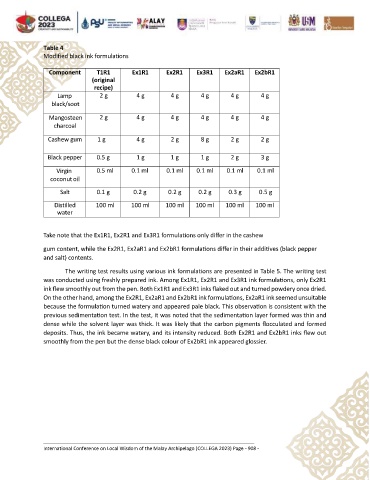
Table 4
               Modified black ink formulations

                 Component       T1R1        Ex1R1      Ex2R1     Ex3R1    Ex2aR1    Ex2bR1
                               (original
                                recipe)
                    Lamp          2 g         4 g         4 g      4 g       4 g       4 g
                  black/soot

                 Mangosteen       2 g         4 g         4 g      4 g       4 g       4 g
                   charcoal

                 Cashew gum       1 g         4 g         2 g      8 g       2 g       2 g


                 Black pepper         0.5 g   1 g         1 g      1 g       2 g       3 g

                    Virgin           0.5 ml     0.1 ml   0.1 ml   0.1 ml    0.1 ml    0.1 ml
                  coconut oil

                     Salt            0.1 g     0.2 g     0.2 g     0.2 g     0.3 g     0.5 g

                   Distilled      100 ml    100 ml      100 ml    100 ml    100 ml    100 ml
                    water


               Take note that the Ex1R1, Ex2R1 and Ex3R1 formulations only differ in the cashew

               gum content, while the Ex2R1, Ex2aR1 and Ex2bR1 formulations differ in their additives (black pepper
               and salt) contents.

                       The writing test results using various ink formulations are presented in Table 5. The writing test
               was conducted using freshly prepared ink. Among Ex1R1, Ex2R1 and Ex3R1 ink formulations, only Ex2R1
               ink flew smoothly out from the pen. Both Ex1R1 and Ex3R1 inks flaked out and turned powdery once dried.
               On the other hand, among the Ex2R1, Ex2aR1 and Ex2bR1 ink formulations, Ex2aR1 ink seemed unsuitable
               because the formulation turned watery and appeared pale black. This observation is consistent with the
               previous sedimentation test. In the test, it was noted that the sedimentation layer formed was thin and
               dense while the solvent layer was thick. It was likely that the carbon pigments flocculated and formed
               deposits. Thus, the ink became watery, and its intensity reduced. Both Ex2R1 and Ex2bR1 inks flew out
               smoothly from the pen but the dense black colour of Ex2bR1 ink appeared glossier.


               International Conference on Local Wisdom of the Malay Archipelago (COLLEGA 2023) Page - 908 -

