


Page 920 - Proceedings Collega2023
P. 920
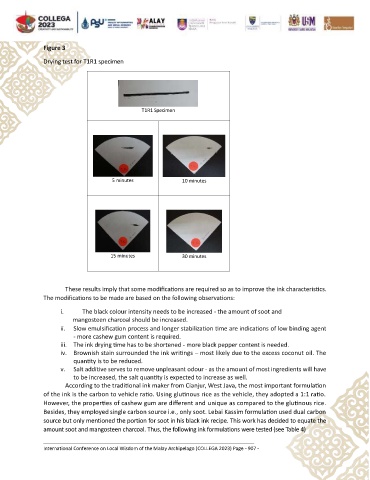
Figure 3

               Drying test for T1R1 specimen


                                                T1R1 Specimen


                                      5 minutes              10 minutes


                                      15 minutes             30 minutes


                       These results imply that some modifications are required so as to improve the ink characteristics.
               The modifications to be made are based on the following observations:

                     i.     The black colour intensity needs to be increased - the amount of soot and
                             mangosteen charcoal should be increased.
                     ii.  Slow emulsification process and longer stabilization time are indications of low binding agent
                         - more cashew gum content is required.
                     iii.  The ink drying time has to be shortened - more black pepper content is needed.
                     iv.  Brownish stain surrounded the ink writings – most likely due to the excess coconut oil. The
                         quantity is to be reduced.
                     v.  Salt additive serves to remove unpleasant odour - as the amount of most ingredients will have
                         to be increased, the salt quantity is expected to increase as well.
                       According to the traditional ink maker from Cianjur, West Java, the most important formulation
               of the ink is the carbon to vehicle ratio. Using glutinous rice as the vehicle, they adopted a 1:1 ratio.
               However, the properties of cashew gum are different and unique as compared to the glutinous rice.
               Besides, they employed single carbon source i.e., only soot. Lebai Kassim formulation used dual carbon
               source but only mentioned the portion for soot in his black ink recipe. This work has decided to equate the
               amount soot and mangosteen charcoal. Thus, the following ink formulations were tested (see Table 4)


               International Conference on Local Wisdom of the Malay Archipelago (COLLEGA 2023) Page - 907 -

