


Page 916 - Proceedings Collega2023
P. 916
At this stage, a simple one-factor-at-a-time (OFAT) approach was adopted i.e. the effect of modifying a
               single factor was observed while putting the other factors constant. The ink formulation was tested for its
               sedimentation and drying absorption. Finally, the feedbacks of professional calligraphers of Malaysia were
               sought on the quality of the screened black ink formulation.

               Materials
                       Wan Ali (1988) described the following black ink recipe based on his personal communication with
               Lebai Kassim Abbas from Pasir Mas, Kelantan. In the Malay culture a lebai refers to a learned person in
               religious knowledge or a mosque servant. Lebai Kassim learned the ink making technique from Islamic
               religious schools (pondoks) where he attended.

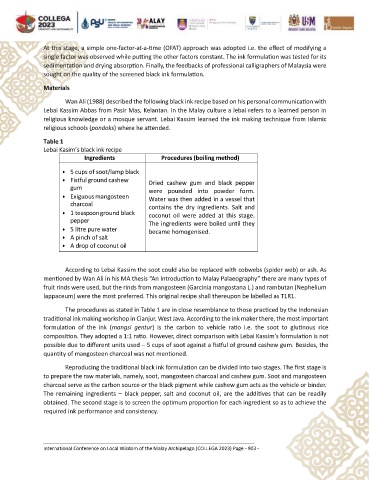
               Table 1
               Lebai Kasim’s black ink recipe
                             Ingredients              Procedures (boiling method)

                      •  5 cups of soot/lamp black

                      •  Fistful ground cashew    Dried  cashew  gum  and  black  pepper
                        gum
                                                  were  pounded  into  powder  form.
                      •  Exiguous mangosteen      Water was then added in a vessel that
                        charcoal
                                                  contains  the  dry  ingredients.  Salt  and
                      •  1 teaspoon ground black   coconut  oil  were  added  at  this  stage.
                        pepper
                                                  The ingredients were boiled until they
                      •  5 litre pure water       became homogenised.
                      •  A pinch of salt
                      •  A drop of coconut oil


                       According to Lebai Kassim the soot could also be replaced with cobwebs (spider web) or ash. As
               mentioned by Wan Ali in his MA thesis “An Introduction to Malay Palaeography” there are many types of
               fruit rinds were used, but the rinds from mangosteen (Garcinia mangostana L.) and rambutan (Nephelium
               lappaceum) were the most preferred. This original recipe shall thereupon be labelled as T1R1.

                       The procedures as stated in Table 1 are in close resemblance to those practiced by the Indonesian
               traditional ink making workshop in Cianjur, West Java. According to the ink maker there, the most important
               formulation  of  the  ink  (mangsi  gentur)  is  the  carbon  to  vehicle  ratio  i.e.  the  soot  to  glutinous  rice
               composition. They adopted a 1:1 ratio. However, direct comparison with Lebai Kassim’s formulation is not
               possible due to different units used – 5 cups of soot against a fistful of ground cashew gum. Besides, the
               quantity of mangosteen charcoal was not mentioned.

                       Reproducing the traditional black ink formulation can be divided into two stages. The first stage is
               to prepare the raw materials, namely, soot, mangosteen charcoal and cashew gum. Soot and mangosteen
               charcoal serve as the carbon source or the black pigment while cashew gum acts as the vehicle or binder.
               The  remaining  ingredients  –  black  pepper,  salt  and coconut  oil,  are  the additives that  can  be  readily
               obtained. The second stage is to screen the optimum proportion for each ingredient so as to achieve the
               required ink performance and consistency.


               International Conference on Local Wisdom of the Malay Archipelago (COLLEGA 2023) Page - 903 -

