


Page 545 - Proceedings Collega2023
P. 545
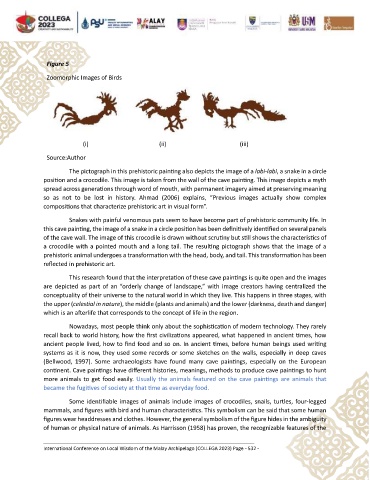
Figure 5
                Zoomorphic Images of Birds


                            (i)                       (ii)                      (iii)

                Source:Author

                        The pictograph in this prehistoric painting also depicts the image of a labi-labi, a snake in a circle
               position and a crocodile. This image is taken from the wall of the cave painting. This image depicts a myth
               spread across generations through word of mouth, with permanent imagery aimed at preserving meaning
               so  as  not  to  be  lost  in  history.  Ahmad  (2006)  explains,  “Previous  images  actually  show  complex
               compositions that characterize prehistoric art in visual form”.

                        Snakes with painful venomous pats seem to have become part of prehistoric community life. In
               this cave painting, the image of a snake in a circle position has been definitively identified on several panels
               of the cave wall. The image of this crocodile is drawn without scrutiny but still shows the characteristics of
               a crocodile with a pointed mouth and a long tail. The resulting pictograph shows that the image of a
               prehistoric animal undergoes a transformation with the head, body, and tail. This transformation has been
               reflected in prehistoric art.

                        This research found that the interpretation of these cave paintings is quite open and the images
               are depicted as part of an “orderly change of landscape,” with image creators having centralized the
               conceptuality of their universe to the natural world in which they live. This happens in three stages, with
               the upper (celestial in nature), the middle (plants and animals) and the lower (darkness, death and danger)
               which is an afterlife that corresponds to the concept of life in the region.

                        Nowadays, most people think only about the sophistication of modern technology. They rarely
               recall back to world history, how the first civilizations appeared, what happened in ancient times, how
               ancient people lived, how to find food and so on. In ancient times, before human beings used writing
               systems as it is now, they used some records or some sketches on the walls, especially in deep caves
               (Bellwood,  1997).  Some  archaeologists  have  found  many  cave  paintings,  especially  on  the  European
               continent. Cave paintings have different histories, meanings, methods to produce cave paintings to hunt
               more animals to get food easily. Usually the animals featured on the cave paintings are animals that
               became the fugitives of society at that time as everyday food.

                        Some identifiable images of animals include images of crocodiles, snails, turtles, four-legged
               mammals, and figures with bird and human characteristics. This symbolism can be said that some human
               figures wear headdresses and clothes. However, the general symbolism of the figure hides in the ambiguity
               of human or physical nature of animals. As Harrisson (1958) has proven, the recognizable features of the


               International Conference on Local Wisdom of the Malay Archipelago (COLLEGA 2023) Page - 532 -

