


Page 541 - Proceedings Collega2023
P. 541
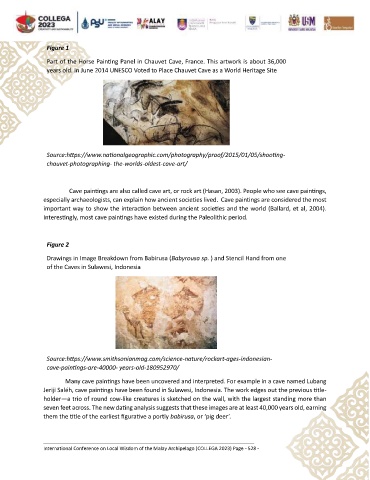
Figure 1

                Part of the Horse Painting Panel in Chauvet Cave, France. This artwork is about 36,000
                years old. In June 2014 UNESCO Voted to Place Chauvet Cave as a World Heritage Site


                Source:https://www.nationalgeographic.com/photography/proof/2015/01/05/shooting-
                chauvet-photographing- the-worlds-oldest-cave-art/


                        Cave paintings are also called cave art, or rock art (Hasan, 2003). People who see cave paintings,
               especially archaeologists, can explain how ancient societies lived.  Cave paintings are considered the most
               important way to show the interaction between ancient societies and the world (Ballard, et al, 2004).
               Interestingly, most cave paintings have existed during the Paleolithic period.


                Figure 2

                Drawings in Image Breakdown from Babirusa (Babyrousa sp. ) and Stencil Hand from one
                of the Caves in Sulawesi, Indonesia


                Source:https://www.smithsonianmag.com/science-nature/rockart-ages-indonesian-
                cave-paintings-are-40000- years-old-180952970/

                       Many cave paintings have been uncovered and interpreted. For example in a cave named Lubang
               Jeriji Saléh, cave paintings have been found in Sulawesi, Indonesia. The work edges out the previous title-
               holder—a trio of round cow-like creatures is sketched on the wall, with the largest standing more than
               seven feet across. The new dating analysis suggests that these images are at least 40,000 years old, earning
               them the title of the earliest figurative a portly babirusa, or ‘pig deer’.


               International Conference on Local Wisdom of the Malay Archipelago (COLLEGA 2023) Page - 528 -

