


Page 333 - Proceedings Collega2023
P. 333
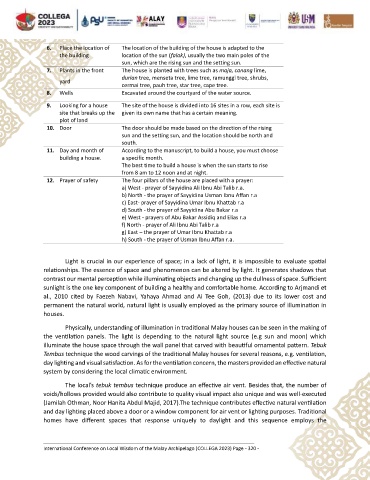
6.   Place the location of   The location of the building of the house is adapted to the
                     the building        location of the sun (falak), usually the two main poles of the
                                         sun, which are the rising sun and the setting sun.
                7.   Plants in the front   The house is planted with trees such as maja, canang lime,
                                         durian tree, menseta tree, lime tree, ramunggi tree, shrubs,
                     yard
                                         cermai tree, pauh tree, star tree, cape tree.
                8.   Wells               Excavated around the courtyard of the water source.
                9.   Looking for a house   The site of the house is divided into 16 sites in a row, each site is
                     site that breaks up the  given its own name that has a certain meaning.
                     plot of land
                10.   Door               The door should be made based on the direction of the rising
                                         sun and the setting sun, and the location should be north and
                                         south.
                11.   Day and month of   According to the manuscript, to build a house, you must choose
                     building a house.   a specific month.
                                         The best time to build a house is when the sun starts to rise
                                         from 8 am to 12 noon and at night.
                12.   Prayer of safety   The four pillars of the house are placed with a prayer:
                                         a) West - prayer of Sayyidina Ali Ibnu Abi Talib r.a.
                                         b) North - the prayer of Sayyidina Usman Ibnu Affan r.a
                                         c) East- prayer of Sayyidina Umar Ibnu Khattab r.a
                                         d) South - the prayer of Sayyidina Abu Bakar r.a
                                         e) West - prayers of Abu Bakar Assidiq and Elias r.a
                                         f) North - prayer of Ali Ibnu Abi Talib r.a
                                         g) East – the prayer of Umar Ibnu Khattab r.a
                                         h) South - the prayer of Usman Ibnu Affan r.a.


                       Light is crucial in our experience of space; in a lack of light, it is impossible to evaluate spatial
               relationships. The essence of space and phenomenon can be altered by light. It generates shadows that
               contrast our mental perception while illuminating objects and changing up the dullness of space. Sufficient
               sunlight is the one key component of building a healthy and comfortable home. According to Arjmandi et
               al.,  2010  cited  by  Faezeh  Nabavi,  Yahaya  Ahmad  and  Ai  Tee  Goh,  (2013)  due  to  its  lower  cost  and
               permanent the natural world, natural light is usually employed as the primary source of illumination in
               houses.

                       Physically, understanding of illumination in traditional Malay houses can be seen in the making of
               the  ventilation  panels.  The  light  is  depending  to  the  natural  light  source  (e.g  sun  and  moon)  which
               illuminate the house space through the wall panel that carved with beautiful ornamental pattern. Tebuk
               Tembus technique the wood carvings of the traditional Malay houses for several reasons, e.g. ventilation,
               day lighting and visual satisfaction. As for the ventilation concern, the masters provided an effective natural
               system by considering the local climatic environment.

                       The local’s tebuk tembus technique produce an effective air vent. Besides that, the number of
               voids/hollows provided would also contribute to quality visual impact also unique and was well-executed
               (Jamilah Othman, Noor Hanita Abdul Majid, 2017).The technique contributes effective natural ventilation
               and day lighting placed above a door or a window component for air vent or lighting purposes. Traditional
               homes  have  different  spaces  that  response  uniquely  to  daylight  and  this  sequence  employs  the


               International Conference on Local Wisdom of the Malay Archipelago (COLLEGA 2023) Page - 320 -

