


Page 330 - Proceedings Collega2023
P. 330
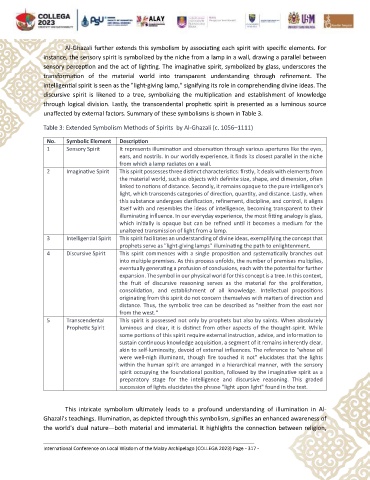
Al-Ghazali further extends this symbolism by associating each spirit with specific elements. For
               instance, the sensory spirit is symbolized by the niche from a lamp in a wall, drawing a parallel between
               sensory perception and the act of lighting. The imaginative spirit, symbolized by glass, underscores the
               transformation  of  the  material  world  into  transparent  understanding  through  refinement.  The
               intelligential spirit is seen as the "light-giving lamp," signifying its role in comprehending divine ideas. The
               discursive  spirit  is  likened  to  a  tree,  symbolizing  the  multiplication  and  establishment  of  knowledge
               through  logical  division.  Lastly,  the transcendental  prophetic  spirit  is  presented  as  a  luminous  source
               unaffected by external factors. Summary of these symbolisms is shown in Table 3.

               Table 3: Extended Symbolism Methods of Spirits  by Al-Ghazali (c. 1056–1111)

                 No.   Symbolic Element   Description
                 1     Sensory Spirit    It represents illumination and observation through various apertures like the eyes,
                                         ears, and nostrils. In our worldly experience, it finds its closest parallel in the niche
                                         from which a lamp radiates on a wall.
                 2     Imaginative Spirit   This spirit possesses three distinct characteristics: firstly, it deals with elements from
                                         the material world, such as objects with definite size, shape, and dimension, often
                                         linked to notions of distance. Secondly, it remains opaque to the pure intelligence's
                                         light, which transcends categories of direction, quantity, and distance. Lastly, when
                                         this substance undergoes clarification, refinement, discipline, and control, it aligns
                                         itself with and resembles the ideas of intelligence, becoming transparent to their
                                         illuminating influence. In our everyday experience, the most fitting analogy is glass,
                                         which  initially  is  opaque  but  can  be  refined  until  it  becomes  a  medium  for  the
                                         unaltered transmission of light from a lamp.
                 3     Intelligential Spirit   This spirit facilitates an understanding of divine ideas, exemplifying the concept that
                                         prophets serve as "light-giving lamps" illuminating the path to enlightenment.
                 4     Discursive Spirit   This spirit commences with a single proposition and systematically branches out
                                         into multiple premises. As this process unfolds, the number of premises multiplies,
                                         eventually generating a profusion of conclusions, each with the potential for further
                                         expansion. The symbol in our physical world for this concept is a tree. In this context,
                                         the  fruit  of  discursive  reasoning  serves  as  the  material  for  the  proliferation,
                                         consolidation,  and  establishment  of  all  knowledge.  Intellectual  propositions
                                         originating from this spirit do not concern themselves with matters of direction and
                                         distance. Thus, the symbolic tree can be described as "neither from the east nor
                                         from the west."
                 5     Transcendental    This spirit is possessed not only by prophets but also by saints. When absolutely
                       Prophetic Spirit   luminous and clear, it is distinct from other aspects of the thought-spirit. While
                                         some portions of this spirit require external instruction, advice, and information to
                                         sustain continuous knowledge acquisition, a segment of it remains inherently clear,
                                         akin to self-luminosity, devoid of external influences. The reference to "whose oil
                                         were  well-nigh  illuminant,  though  fire  touched  it  not"  elucidates  that  the  lights
                                         within the human spirit are arranged in a hierarchical manner, with the sensory
                                         spirit occupying the foundational position, followed by the imaginative spirit as a
                                         preparatory  stage  for  the  intelligence  and  discursive  reasoning.  This  graded
                                         succession of lights elucidates the phrase "light upon light" found in the text.


                       This  intricate  symbolism  ultimately  leads  to  a  profound  understanding  of  illumination  in  Al-
               Ghazali's teachings. Illumination, as depicted through this symbolism, signifies an enhanced awareness of
               the world's dual nature—both material and immaterial. It highlights the connection between religion,


               International Conference on Local Wisdom of the Malay Archipelago (COLLEGA 2023) Page - 317 -

