


Page 299 - Proceedings Collega2023
P. 299
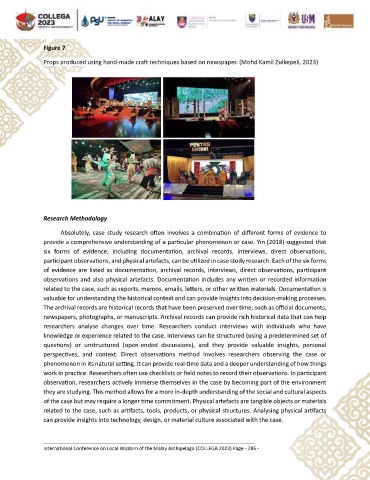
Figure 7

               Props produced using hand-made craft techniques based on newspaper. (Mohd Kamil Zulkepeli, 2023)


               Research Methodology

                     Absolutely,  case  study  research  often  involves  a  combination  of  different  forms  of  evidence  to
               provide a comprehensive understanding of a particular phenomenon or case. Yin (2018) suggested that
               six  forms  of  evidence,  including  documentation,  archival  records,  interviews,  direct  observations,
               participant observations, and physical artefacts, can be utilized in case study research. Each of the six forms
               of  evidence  are  listed  as documentation,  archival records,  interviews,  direct observations,  participant
               observations and also physical artefacts. Documentation includes any written or recorded information
               related to the case, such as reports, memos, emails, letters, or other written materials. Documentation is
               valuable for understanding the historical context and can provide insights into decision-making processes.
               The archival records are historical records that have been preserved over time, such as official documents,
               newspapers, photographs, or manuscripts. Archival records can provide rich historical data that can help
               researchers  analyse  changes  over  time.  Researchers  conduct  interviews  with  individuals  who  have
               knowledge or experience related to the case. Interviews can be structured (using a predetermined set of
               questions)  or  unstructured  (open-ended  discussions),  and  they  provide  valuable  insights,  personal
               perspectives,  and  context.  Direct  observations  method  involves  researchers  observing  the  case  or
               phenomenon in its natural setting. It can provide real-time data and a deeper understanding of how things
               work in practice. Researchers often use checklists or field notes to record their observations. In participant
               observation, researchers actively immerse themselves in the case by becoming part of the environment
               they are studying. This method allows for a more in-depth understanding of the social and cultural aspects
               of the case but may require a longer time commitment. Physical artefacts are tangible objects or materials
               related to the case, such as artifacts, tools, products, or physical structures. Analysing physical artifacts
               can provide insights into technology, design, or material culture associated with the case.


               International Conference on Local Wisdom of the Malay Archipelago (COLLEGA 2023) Page - 286 -

