


Page 284 - Proceedings Collega2023
P. 284
categorized using the basic format of an auditorium as cited in the literature review. The audience to
               stage relationship was examined according to basic stage format as shown in Figure 2. The seating
               arrangement would be categorized into respective types as shown in Figure 3.

                4. FINDINGS AND DISCUSSIONS
               4.1.    Relationship between the auditorium design and performance structure in Sarawak Cultural
               Village.
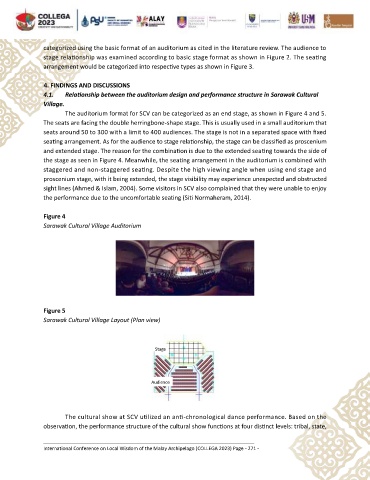
                       The auditorium format for SCV can be categorized as an end stage, as shown in Figure 4 and 5.
               The seats are facing the double herringbone-shape stage. This is usually used in a small auditorium that
               seats around 50 to 300 with a limit to 400 audiences. The stage is not in a separated space with fixed
               seating arrangement. As for the audience to stage relationship, the stage can be classified as proscenium
               and extended stage. The reason for the combination is due to the extended seating towards the side of
               the stage as seen in Figure 4. Meanwhile, the seating arrangement in the auditorium is combined with
               staggered and non-staggered seating. Despite the high viewing angle when using end stage and
               proscenium stage, with it being extended, the stage visibility may experience unexpected and obstructed
               sight lines (Ahmed & Islam, 2004). Some visitors in SCV also complained that they were unable to enjoy
               the performance due to the uncomfortable seating (Siti Normaheram, 2014).

               Figure 4
               Sarawak Cultural Village Auditorium


               Figure 5
               Sarawak Cultural Village Layout (Plan view)


                                                    Stage


                                                   Audience


                       The cultural show at SCV utilized an anti-chronological dance performance. Based on the
               observation, the performance structure of the cultural show functions at four distinct levels: tribal, state,


               International Conference on Local Wisdom of the Malay Archipelago (COLLEGA 2023) Page - 271 -

