


Page 282 - Proceedings Collega2023
P. 282
2.2.     Auditorium Design
                       An auditorium is an area within a complex building which commonly has multiple purposes of
               function such as to accommodate meetings, lectures, small-scale theatre plays, concerts and several
               types of video and picture presentations (Haapoja & Tikka, 1999, 44). Auditoriums are situated in culture
               centers, conference centers, hotels, and other complex buildings such as educational centers. Large, high-
               class auditoriums can have a seating capacity of even 1500-3500 seats (Bedouk International, the
               worldwide meeting planners’ guide, 2005). For example, the Malmö Exhibition and Convention Center
               can seat 3500 persons in its largest auditorium (Op. Cit. p. 309). The seats are usually organized as a
               theatre plan in which the seating is raised, and the seats face directly towards the stage. This is one of
               the most essential factors which affect the stage visibility (Ahmed & Islam, 2004). A general characteristic
               of an auditorium of any size is the fact that program varies, and visitors represent several diverse types of
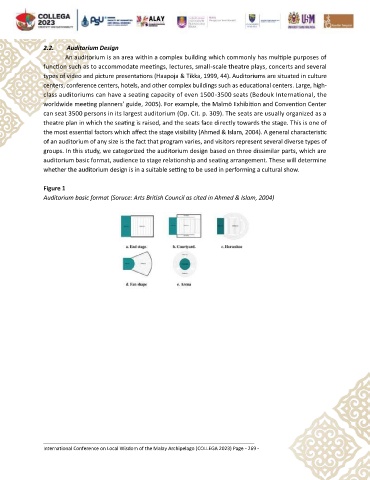
               groups. In this study, we categorized the auditorium design based on three dissimilar parts, which are
               auditorium basic format, audience to stage relationship and seating arrangement. These will determine
               whether the auditorium design is in a suitable setting to be used in performing a cultural show.

               Figure 1
               Auditorium basic format (Soruce: Arts British Council as cited in Ahmed & Islam, 2004)


               International Conference on Local Wisdom of the Malay Archipelago (COLLEGA 2023) Page - 269 -

