


Page 730 - Proceedings Collega2023
P. 730
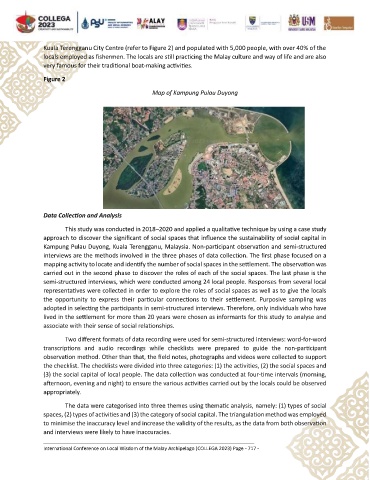
Kuala Terengganu City Centre (refer to Figure 2) and populated with 5,000 people, with over 40% of the
               locals employed as fishermen. The locals are still practicing the Malay culture and way of life and are also
               very famous for their traditional boat-making activities.

               Figure 2
                                                   Map of Kampung Pulau Duyong


               Data Collection and Analysis

                       This study was conducted in 2018–2020 and applied a qualitative technique by using a case study
               approach to discover the significant of social spaces that influence the sustainability of social capital in
               Kampung Pulau Duyong, Kuala Terengganu, Malaysia. Non-participant observation and semi-structured
               interviews are the methods involved in the three phases of data collection. The first phase focused on a
               mapping activity to locate and identify the number of social spaces in the settlement. The observation was
               carried out in the second phase to discover the roles of each of the social spaces. The last phase is the
               semi-structured interviews, which were conducted among 24 local people. Responses from several local
               representatives were collected in order to explore the roles of social spaces as well as to give the locals
               the  opportunity  to  express  their  particular  connections  to  their  settlement.  Purposive  sampling  was
               adopted in selecting the participants in semi-structured interviews. Therefore, only individuals who have
               lived in the settlement for more than 20 years were chosen as informants for this study to analyse and
               associate with their sense of social relationships.
                       Two different formats of data recording were used for semi-structured interviews: word-for-word
               transcriptions  and  audio  recordings  while  checklists  were  prepared  to  guide  the  non-participant
               observation method. Other than that, the field notes, photographs and videos were collected to support
               the checklist. The checklists were divided into three categories: (1) the activities, (2) the social spaces and
               (3) the social capital of local people. The data collection was conducted at four-time intervals (morning,
               afternoon, evening and night) to ensure the various activities carried out by the locals could be observed
               appropriately.

                       The data were categorised into three themes using thematic analysis, namely: (1) types of social
               spaces, (2) types of activities and (3) the category of social capital. The triangulation method was employed
               to minimise the inaccuracy level and increase the validity of the results, as the data from both observation
               and interviews were likely to have inaccuracies.


               International Conference on Local Wisdom of the Malay Archipelago (COLLEGA 2023) Page - 717 -

