


Page 729 - Proceedings Collega2023
P. 729
informal, and unregulated interactions. The concept of home is commonly referred to as the initial setting
               that provides individuals with a domestic atmosphere conducive to leisure. However, it is important to
               acknowledge that the upkeep of a home necessitates both effort and financial investment.

                       According to Woldoff et al. (2013), the work environment might be considered as a "second place"
               where  productive  outcomes  are  generated.  According  to  Alidoust  et  al.,  (2015),  the  purpose  of
               constructing the third place is to enhance the overall well-being of local communities and facilitate the
               development  of  social  connections.  Social  space  serves  as  a  platform  for  fostering  relationships  and
               facilitating  physical  exercise  through  voluntary  community  engagement  (Urry,  2001).  Moreover,  the
               concept of the third place contributes to the equilibrium of individuals' lives by facilitating the cultivation
               of  self-awareness  through  social  interactions  within  the  community,  subsequent  to  the  fulfilment  of
               primary responsibilities in the realms of employment and familial roles (Oldenburg, 1999; Williams & Hipp,
               2019). The third place serves as a means of alleviating stress for individuals, providing a respite from the
               daily  pressures  associated  with  both  domestic  and  professional  responsibilities.  Participating  in
               community activities fosters a sense of engagement. Furthermore, it promotes the development of local
               political dedication to the community through the means of public conversation (Jeffres et al., 2009).
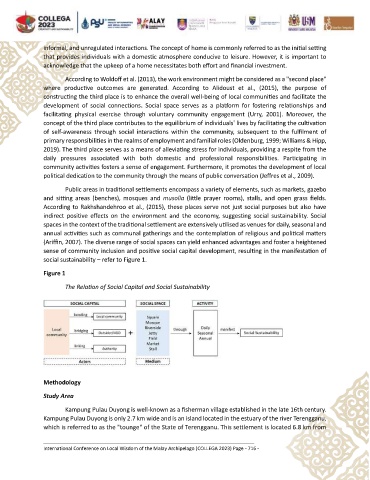
                       Public areas in traditional settlements encompass a variety of elements, such as markets, gazebo
               and  sitting  areas  (benches),  mosques  and  musolla  (little  prayer  rooms),  stalls,  and  open  grass  fields.
               According to Rakhshandehroo et al., (2015), these places serve not just social purposes but also have
               indirect  positive  effects  on  the  environment  and  the  economy,  suggesting  social  sustainability.  Social
               spaces in the context of the traditional settlement are extensively utilised as venues for daily, seasonal and
               annual activities such as communal gatherings and the contemplation of religious and political matters
               (Ariffin, 2007). The diverse range of social spaces can yield enhanced advantages and foster a heightened
               sense of community inclusion and positive social capital development, resulting in the manifestation of
               social sustainability – refer to Figure 1.

               Figure 1

                       The Relation of Social Capital and Social Sustainability


               Methodology

               Study Area

                       Kampung Pulau Duyong is well-known as a fisherman village established in the late 16th century.
               Kampung Pulau Duyong is only 2.7 km wide and is an island located in the estuary of the river Terengganu,
               which is referred to as the "tounge" of the State of Terengganu. This settlement is located 6.8 km from


               International Conference on Local Wisdom of the Malay Archipelago (COLLEGA 2023) Page - 716 -

