


Page 623 - Proceedings Collega2023
P. 623
(2007)  emphasized  Intercultural  Communication  is  a  synthesis  of  diverse  forms  of  relationships,
               interaction, and communication between individuals or groups from different cultures. Based on these
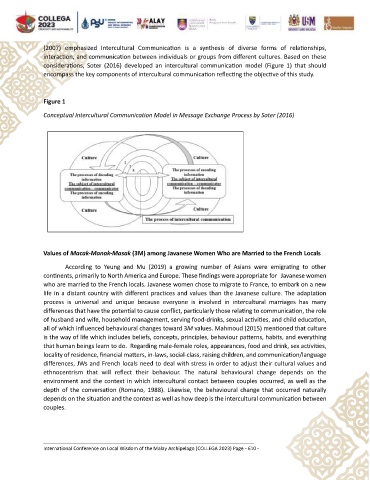
               considerations,  Soter  (2016)  developed  an  intercultural  communication  model  (Figure  1)  that  should
               encompass the key components of intercultural communication reflecting the objective of this study.


               Figure 1

               Conceptual Intercultural Communication Model in Message Exchange Process by Soter (2016)


               Values of Macak-Manak-Masak (3M) among Javanese Women Who are Married to the French Locals
                       According  to  Yeung  and  Mu  (2019)  a  growing  number  of  Asians  were  emigrating  to  other
               continents, primarily to North America and Europe. These findings were appropriate for   Javanese women
               who are married to the French locals. Javanese women chose to migrate to France, to embark on a new
               life in a distant country with different practices and values than the Javanese culture. The adaptation
               process  is  universal  and  unique  because  everyone  is  involved  in  intercultural  marriages  has  many
               differences that have the potential to cause conflict, particularly those relating to communication, the role
               of husband and wife, household management, serving food-drinks, sexual activities, and child education,
               all of which influenced behavioural changes toward 3M values. Mahmoud (2015) mentioned that culture
               is the way of life which includes beliefs, concepts, principles, behaviour patterns, habits, and everything
               that human beings learn to do.  Regarding male-female roles, appearances, food and drink, sex activities,
               locality of residence, financial matters, in-laws, social-class, raising children, and communication/language
               differences, JWs and French locals need to deal with stress in order to adjust their cultural values and
               ethnocentrism  that  will  reflect  their  behaviour.  The  natural  behavioural  change  depends  on  the
               environment and the context in which intercultural contact between couples occurred, as well as the
               depth  of  the  conversation  (Romano,  1988).  Likewise,  the  behavioural  change  that  occurred  naturally
               depends on the situation and the context as well as how deep is the intercultural communication between
               couples.


               International Conference on Local Wisdom of the Malay Archipelago (COLLEGA 2023) Page - 610 -

