


Page 1080 - Proceedings Collega2023
P. 1080
concept in Malaysia, the significance of adapting this concept within the country, and the pertinence of
               implementing the concept within the framework of a multicultural society. The results and discussions are
               presented in the following section.


               The Movement of the Islamic Garden Concept in Response to the History of the Muslim Civilization

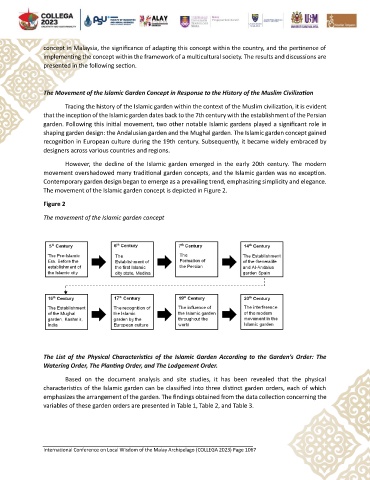
                       Tracing the history of the Islamic garden within the context of the Muslim civilization, it is evident
               that the inception of the Islamic garden dates back to the 7th century with the establishment of the Persian
               garden. Following this initial movement, two other notable Islamic gardens played a significant role in
               shaping garden design: the Andalusian garden and the Mughal garden. The Islamic garden concept gained
               recognition in European culture during the 19th century. Subsequently, it became widely embraced by
               designers across various countries and regions.

                       However,  the  decline  of  the  Islamic  garden  emerged  in  the  early  20th  century.  The  modern
               movement overshadowed many traditional garden concepts, and the Islamic garden was no exception.
               Contemporary garden design began to emerge as a prevailing trend, emphasizing simplicity and elegance.
               The movement of the Islamic garden concept is depicted in Figure 2.

               Figure 2
               The movement of the Islamic garden concept


               The List of the Physical  Characteristics of the Islamic Garden According to the Garden’s Order: The
               Watering Order, The Planting Order, and The Lodgement Order.
                       Based  on  the  document  analysis  and  site  studies,  it  has  been  revealed  that  the  physical
               characteristics of the Islamic garden can be classified into three distinct garden orders, each of which
               emphasizes the arrangement of the garden. The findings obtained from the data collection concerning the
               variables of these garden orders are presented in Table 1, Table 2, and Table 3.


               International Conference on Local Wisdom of the Malay Archipelago (COLLEGA 2023) Page 1067

