


Page 975 - Proceedings Collega2023
P. 975
Data will be gathered as well through In-depth interviews. Interview is one of the most important
               tools by which researcher will gather data from important figures of the communities and individuals who
               had a role in the process of promoting, selling and designing the cultural costumes in three southern
               border provinces. The interview and conversation will be done as well with government cultural office
               administrators/officials, community elders and other key informants – here the key informants referring
               to individuals who have major role such as the designer and seller who are directly involved in the whole
               designing and promoting process of the costume. There will be also an informal discussion with different
               individuals (10 informants from each province). Informants were selected based on their knowledge about
               the issue under discussion and based on their participation in the promotion process of these cultural
               costumes.
               Study Area Description

                       This research is targeted at one ethnic group from southern border province of Thailand - the
               ethnic Thai Malays. 'Malay', is a term used to refer to ethnic Malay citizens of Thailand. They are Muslims
               and speak a dialect of Malay known as Patani-Malay. The ethnic Thai Malays or also known (in other
               academic writings) as Malay Muslims, constitute 18 per cent of Thai Muslims.  Most ethnic Malays live
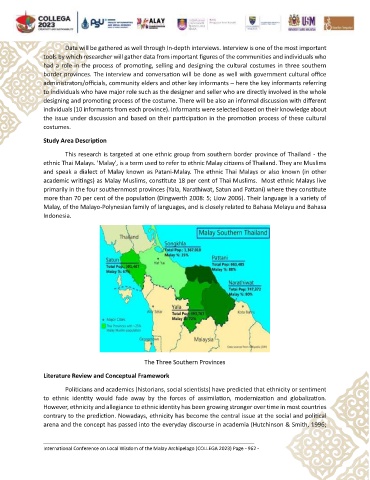
               primarily in the four southernmost provinces (Yala, Narathiwat, Satun and Pattani) where they constitute
               more than 70 per cent of the population (Dingwerth 2008: 5; Liow 2006). Their language is a variety of
               Malay, of the Malayo-Polynesian family of languages, and is closely related to Bahasa Melayu and Bahasa
               Indonesia.


                                                 The Three Southern Provinces

               Literature Review and Conceptual Framework
                       Politicians and academics (historians, social scientists) have predicted that ethnicity or sentiment

               to  ethnic  identity  would  fade  away  by  the  forces  of  assimilation,  modernization  and  globalization.
               However, ethnicity and allegiance to ethnic identity has been growing stronger over time in most countries
               contrary to the prediction. Nowadays, ethnicity has become the central issue at the social and political
               arena and the concept has passed into the everyday discourse in academia (Hutchinson & Smith, 1996;


               International Conference on Local Wisdom of the Malay Archipelago (COLLEGA 2023) Page - 962 -

