


Page 904 - Proceedings Collega2023
P. 904
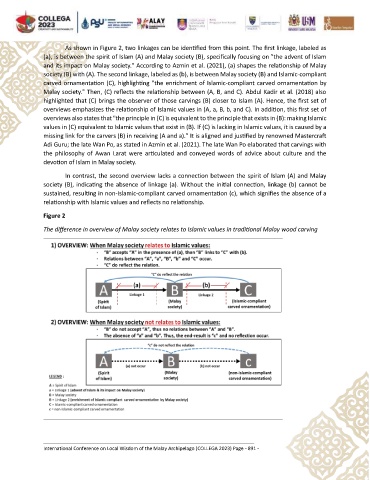
As shown in Figure 2, two linkages can be identified from this point. The first linkage, labeled as
               (a), is between the spirit of Islam (A) and Malay society (B), specifically focusing on "the advent of Islam
               and its impact on Malay society." According to Azmin et al. (2021), (a) shapes the relationship of Malay
               society (B) with (A). The second linkage, labeled as (b), is between Malay society (B) and Islamic-compliant
               carved ornamentation (C), highlighting "the enrichment of Islamic-compliant carved ornamentation by
               Malay society." Then, (C) reflects the relationship between (A, B, and C). Abdul Kadir et al. (2018) also
               highlighted that (C) brings the observer of those carvings (B) closer to Islam (A). Hence, the first set of
               overviews emphasizes the relationship of Islamic values in (A, a, B, b, and C). In addition, this first set of
               overviews also states that "the principle in (C) is equivalent to the principle that exists in (B): making Islamic
               values in (C) equivalent to Islamic values that exist in (B). If (C) is lacking in Islamic values, it is caused by a
               missing link for the carvers (B) in receiving (A and a)." It is aligned and justified by renowned Mastercraft
               Adi Guru; the late Wan Po, as stated in Azmin et al. (2021). The late Wan Po elaborated that carvings with
               the  philosophy of  Awan  Larat  were  articulated  and conveyed words  of  advice  about  culture and  the
               devotion of Islam in Malay society.

                       In contrast, the second overview lacks a connection between the spirit of Islam (A) and Malay
               society (B), indicating the absence of linkage (a). Without the initial connection, linkage (b) cannot be
               sustained, resulting in non-Islamic-compliant carved ornamentation (c), which signifies the absence of a
               relationship with Islamic values and reflects no relationship.

               Figure 2
               The difference in overview of Malay society relates to Islamic values in traditional Malay wood carving


               International Conference on Local Wisdom of the Malay Archipelago (COLLEGA 2023) Page - 891 -

