


Page 903 - Proceedings Collega2023
P. 903
of traditional Malay wood carvings are rooted in the concept of Tawhid, which is the Oneness of God (Allah
               SWT)  (Abu  Hassan  et  al.,  2016).  Therefore,  these  traditional  carvings  can  be  considered  as  Islamic-
               compliant carved ornamentation.

                       Traditional Islamic arts have embraced Islamic values as their foundation. Consequently, Samat @
               Darawi et al. (2017) has highlighted that the development of traditional craftsmanship aligns harmoniously
               with Islamic teachings. In Malay society, Islam has not only influenced the spiritual aspect of traditional
               craftsmanship but also its external beauty. As a result, traditional carvings have gained prominence as a
               fusion of wisdom and art (Ahmad et al., 2022). Traditional carvings are deeply appreciated by the Malay
               society  for  embodying  Islamic  values.  The  effective  visual  conveyance  of  Islamic  teachings  through
               traditional Malay wood carvings is evident in the positive response from the Malay society (Othman &
               Abdul Majid, 2017). For traditional craftsmen, ensuring society's access to beneficial knowledge through
               Islamic values has become their primary objective.

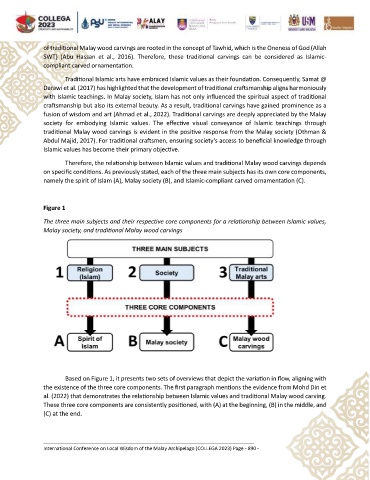
                       Therefore, the relationship between Islamic values and traditional Malay wood carvings depends
               on specific conditions. As previously stated, each of the three main subjects has its own core components,
               namely the spirit of Islam (A), Malay society (B), and Islamic-compliant carved ornamentation (C).


               Figure 1

               The three main subjects and their respective core components for a relationship between Islamic values,
               Malay society, and traditional Malay wood carvings


                       Based on Figure 1, it presents two sets of overviews that depict the variation in flow, aligning with
               the existence of the three core components. The first paragraph mentions the evidence from Mohd Din et
               al. (2022) that demonstrates the relationship between Islamic values and traditional Malay wood carving.
               These three core components are consistently positioned, with (A) at the beginning, (B) in the middle, and
               (C) at the end.


               International Conference on Local Wisdom of the Malay Archipelago (COLLEGA 2023) Page - 890 -

