


Page 719 - Proceedings Collega2023
P. 719
culinary techniques. These traditions are deeply knotted with cultural practices, making food an integral
               part of Malaysian culture.

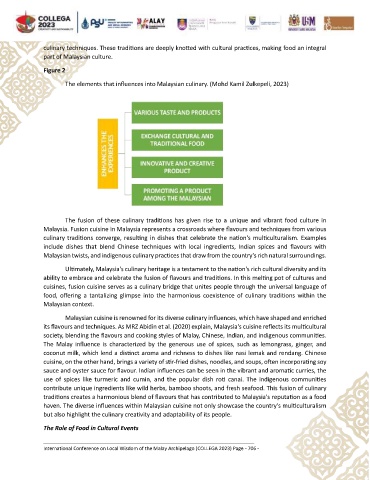
               Figure 2

                       The elements that influences into Malaysian culinary. (Mohd Kamil Zulkepeli, 2023)


                       The  fusion of  these culinary  traditions  has  given  rise  to  a  unique  and vibrant  food culture  in
               Malaysia. Fusion cuisine in Malaysia represents a crossroads where flavours and techniques from various
               culinary traditions converge, resulting in dishes that celebrate the nation's multiculturalism. Examples
               include  dishes  that  blend  Chinese  techniques  with  local  ingredients,  Indian  spices  and  flavours  with
               Malaysian twists, and indigenous culinary practices that draw from the country's rich natural surroundings.

                       Ultimately, Malaysia's culinary heritage is a testament to the nation's rich cultural diversity and its
               ability to embrace and celebrate the fusion of flavours and traditions. In this melting pot of cultures and
               cuisines, fusion cuisine serves as a culinary bridge that unites people through the universal language of
               food,  offering  a  tantalizing  glimpse  into  the  harmonious  coexistence  of  culinary  traditions  within  the
               Malaysian context.

                       Malaysian cuisine is renowned for its diverse culinary influences, which have shaped and enriched
               its flavours and techniques. As MRZ Abidin et al. (2020) explain, Malaysia's cuisine reflects its multicultural
               society, blending the flavours and cooking styles of Malay, Chinese, Indian, and indigenous communities.
               The  Malay  influence  is  characterized  by  the  generous  use  of  spices,  such  as  lemongrass,  ginger,  and
               coconut milk, which lend a distinct aroma and richness to dishes like nasi lemak and rendang. Chinese
               cuisine, on the other hand, brings a variety of stir-fried dishes, noodles, and soups, often incorporating soy
               sauce and oyster sauce for flavour. Indian influences can be seen in the vibrant and aromatic curries, the
               use  of  spices  like  turmeric  and  cumin,  and  the  popular  dish  roti  canai.  The  indigenous  communities
               contribute unique ingredients like wild herbs, bamboo shoots, and fresh seafood. This fusion of culinary
               traditions creates a harmonious blend of flavours that has contributed to Malaysia's reputation as a food
               haven. The diverse influences within Malaysian cuisine not only showcase the country's multiculturalism
               but also highlight the culinary creativity and adaptability of its people.

               The Role of Food in Cultural Events


               International Conference on Local Wisdom of the Malay Archipelago (COLLEGA 2023) Page - 706 -

